Slow looking
Nothing is as it should be – Looking, slowly.
Ejiri in Suruga Province.
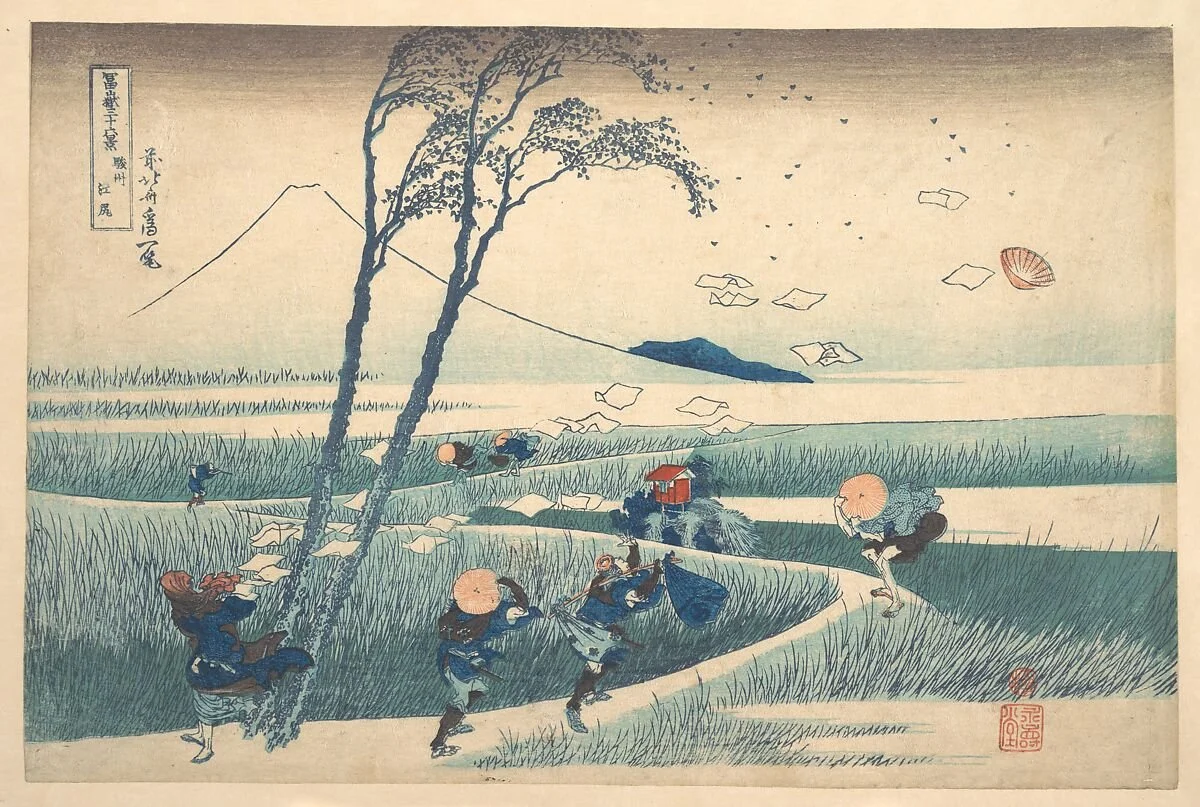
The first time I looked at a painting – really, really looked – was in June 2024 when I went along with my mother to a conference in Hamburg. On our second day there, while she spent the afternoon at the conference, I spent some time wandering around the city, in search of something beautiful.
While in London the month prior, I came across the concept of “slow looking” for the first time: the idea that only by looking at a piece of art for a long period, spending quality time with it, could you hope to truly engage with it or take anything away from it. There are all sorts of statistics around the average amount of time gallery-goers spend in front of works of art – one 2017 study found that on average people spent just over 27 seconds looking at great works.
As a casual enthusiast, I can admit to myself that I was, and still am, among the hurrying average.
I therefore made it my mission to explore this way of looking when I got some time off in Hamburg. I was feeling burnt out, my brain in need of something to focus on other than work. Not one to do things by halves, I decided to really challenge myself, and look at something for thirty minutes. I knew this would feel like a lifetime for my monkey brain and resolved that I would dull the ache of my impatience only with the assistance of some accompanying music.
I went to a gallery which happened to feature an exhibition of Japanese art. I wasn’t immediately drawn to anything, but during my walkaround, I kept coming back to a piece – small and unimposing, even the paper on which it appeared seemed dull and aged. It was as though everything about it was screamed “don’t look at me”. Of course, this was the piece I settled on for my experiment. I later learned that the piece is a lesser-known part of an extremely well-known 18th Century series, the Thirty-Six Views of Mount Fuji, by Katsushika Hokusai. If the series were an album, The Great Wave Over Kanagawa would be the lead track.
No. 18 in the series, Ejiri in Suruga Province, captured me because of its first-glance simplicity and its size - I think this is the kind of work you could look at for thirty seconds and think you’ve seen all it has to offer. I know this is how I felt, after minute five. But as I continued to stare at it from afar, up close, at one angle then another, I found myself sinking into lines of questioning I would never have considered in five minutes. It’s a deepened curiosity, sort of how you feel on a first date with someone you think you might be really into.
First, I was taken in by the sense of movement in stillness. The people walking on the path appear to be on a journey – while it’s not clear if it’s a long walk or a short one, what’s obvious is we’re witnessing a moment of disarray. We watch as they experience an unexpected glitch in the journey; it’s near-cinematic in its force. The image of people crouching, hands flailing on the path is more than active, they are undone and in a state of unexpected transition, an impression accented by the pieces of paper flying, slightly out their grasp, and faces, some of which we cannot see, masked by their clothes blowing around during what’s clearly a very windy day. You get a feel for an event simply out of the control of these characters, such that the eight humans in the frame relinquish their rightful roles as potential protagonists. The action itself draws the eye, rather than a particular individual: in a sense, the wind is the real main character, scattering everything it touches. The people are literally being masked by their circumstance - caught in the wind but their faces, though not shown, remain to me very real and fixed. Their personhood is veiled, but it’s there, somewhere.
You wonder whether, if you could see their faces, you might detect a smile on the corner of their lips. You can almost see what happens next in the story. Maybe the woman tries to gather the bits of paper, and she pulls the clothes out of her face. Everyone holds down their hats and their skirts a little harder and walks with a little more of a strain. How human is that? For things to go wrong, for your papers to go flying, for you to realise that maybe you’re not completely appropriately dressed for the afternoon.
All the while, Mount Fuji is in the background, steadfast. She is the only thing in the image that is as it should be, unmoving. In the background, her presence is slightly off centre but still a grounding force. She’s the last thing that draws your eye in the image, her lines faint to communicate her distance. Like the assertive parent to an unruly toddler, she stands firm amid the relative chaos in the foreground. She’s the last thing your eye is drawn to; ironic, in my view, for a series that bears her name.
So, I have titled this essay “nothing is as it should be”. The people’s journey on their path has been disrupted. Nothing is as it should be, not the clothes, the papers, the trees, everything is displaying some element of disorder except for Mount Fuji.
The natural world flexes her muscle, both in her power to upend (the wind) and her ability to ground (the mountain).
Long after my trip to Hamburg where I first encountered this painting, I was able to visit Tokyo. Among other amazing experiences, I took the time to visit the Hokusai museum, to learn a bit more about the historical context of this painting which seemed to have stayed with me. Ukiyo-e - the word itself meaning “pictures of the floating world”, are formed by carvings are etched onto a woodblock, which are then inked and then used to create prints. The initial carvings, though time consuming, could then be used and re-used to produce the prints. The “floating world” typically referred to images depicting the more carnal pleasures of the time – however, Hokusai, along with other artists of his school, took this art form and used it to depict the sheer power of the natural world, itself a type of “floating” world. Moments in nature like the one depicted can be fleeting, lasting a moment until order is restored.
Of course, within the context of the wider Thiry Six Views of Mount Fuji, this is just one “view”. However, given I’m writing about Slow looking, I think a series wherein the artist took the time to look at this mountain thirty-six times, is an apt place to start.
I would love to spend as much time looking at all the pieces as I spent looking at this one, but to use its most famous sibling, The Great Wave, as a comparison point, ultimately it seems to me that Hokusai was not just enamoured by the mountain, but by life itself. By its mundanity, as well as its splendour, by earth, and by water, by waves and by wind, by people up close, like in Ejiri or from such a distance that if you look in passing you might not realise they’re there, as in the Wave.
I think there is something meaningful, maybe even crucial, in spending just a modicum of the amount of time the artist spent creating, on simply looking, so that we can, as it were, pick up whatever they are putting down.
I was excited to finally see Mount Fuji for myself. It had been a year and a half since I encountered the painting in Hamburg, and I was looking forward to seeing the behemoth that had inspired thirty-six paintings. After a false start, (a cable car journey on a very foggy day clouded my view), my friend and I took a train from Tokyo to Kyoto on our shared birthday, a memorable experience for many reasons, not least because I finally got a good view of the infamous landmark I’d been trying to see all week. From some angles, she was almost unremarkable, and from others she was positively breathtaking. I’m sure it depends on where you’re looking from.